
Blog / Masterclass · 5 min read
Why AI Won't Fix a Broken Foundation: Shiffy Leifer on What to Fix First
Most founders are solving the wrong problem. Layer AI on top of broken operations and you get faster chaos. In this masterclass, ClareOps founder Shiffy Leifer and Colin Pal work through what has to be fixed before you automate anything.
 Colin Pal
Recorded 13 May 2026 · Published 2 November 2026

- The Random Tuesday
- You Don't Have a Time Problem
- Hold Up the Mirror: Three Things to Do First
- The Ready-for-AI Test
- Build the Business Brain
- Where Delegating to AI Goes Wrong
- One Move That Moves Everything
- Where the EA Role Goes From Here
- Frequently Asked Questions
Key takeaways
- You do not have a time problem. You have a structural one: the context lives in your head or scattered across tools, so everything routes back to you.
- AI only gets work that passes the ready-for-AI test: repeatable, rule-based, and already mastered by a human who wrote it down.
- The one move that moves everything else: write down how you actually run the business today, starting with how you get a client.
Every founder we meet has already bought the tools. ChatGPT, Claude, a Grok bot, an automation platform or three. And most of them tell us some version of the same thing: nothing really changed. Same headaches, same seventy-hour weeks, same feeling that the business cannot run without them.
Shiffy Leifer has spent years inside exactly those businesses. Her firm, ClareOps, has helped founders reclaim over 2,000 hours and surface more than a million dollars in hidden revenue, mostly by fixing things that had nothing to do with AI. In this Atlas Expert Masterclass, she and Colin go through what actually breaks, why the tools do not fix it, and the order to do things in.

Watch on YouTube · More from the Atlas channel
The Random Tuesday
Shiffy opens with a day most founders will recognise. The alarm goes at six. Before your feet touch the floor you are on your phone checking whether the team did the thing. They did not, or they did it wrong, so you do it yourself, which teaches everyone that the fastest route is still through you. Every decision comes to your desk. You are physically holding the business together with your hands, and you cannot let go because it will collapse.
The part nobody says out loud is what that does over time. Founders start to quietly resent the business they built. Not because it is failing, but because the details swallowed the vision whole.
When you put AI on top of broken operations, it does not fix the foundation. You just get faster chaos.
You Don't Have a Time Problem
Colin's reflection after placing more than 300 EAs is blunt: founders arrive asking to buy back their time, and time is almost never the real problem. The problem is structural. The context, the institutional knowledge and the preferences live in the founder's head or are scattered across a dozen tools. So the team plays scavenger hunt or comes to you, and you are the bottleneck by design.
Shiffy's version: founders are so deep inside the business that they can only see what is burning right now. The product launch that went wrong is a symptom. The cause is usually a conversation that did not happen last quarter, a role that was never clearly defined, or a decision that landed with you when it should not have. If you only fix the symptom, you will fix it again next quarter.
Hold Up the Mirror: Three Things to Do First
Before any tool, Shiffy asks founders to do three things.
- Ask your team the questions nobody asks. Not "how is the project going?" but "what is draining you?", "what should be a role that is not?", "what would you hand to someone else tomorrow?" The answers will surprise you, and the people answering will feel seen for the first time in months.
- Audit your tools ruthlessly. If you cannot say what a tool is for, you do not need it. Find the duplicates. Get lean.
- Document the basics. Not fancy SOPs. A plain document that says how you get a client, how you onboard them, how you deliver, how you run a launch, how you offboard. This is the foundation every tool, AI or otherwise, will sit on.
In practice. Shiffy's own version of the time audit came from Alex Hormozi. For one week, an alarm every twenty minutes from 8am to 6pm, and two questions each time: what did I just do, and did anything annoy me? It is uncomfortable and it finds more opportunities to automate or eliminate than any dashboard. For team members who will not do that, a deep 20 to 25 question questionnaire works, as long as it is framed as "help me make your life easier" and not as an audit.
Colin's framing for the team matters here. If it sounds like "I am auditing you so AI can replace you", cortisol goes up and honesty goes down. If it sounds like "your genius is not updating a CRM by hand, help me get that off your plate", you get the real workflow.
The Ready-for-AI Test
Most people delegate to AI randomly and are shocked by random results. Shiffy's rule is that a task goes to AI only if it passes all three:
- Repeatable. It happens over and over, not once a year.
- Rule-based. There are clear rules you can hand over.
- Already mastered by a human. The person who mastered it knows what went wrong last time and where the exceptions are. When that is written down, the AI gets wisdom, not just instructions.
Everything else stays with people: the judgment calls, the relationships, the conversation with the client who is upset and needs to feel heard. Colin pairs it with the framework Atlas uses internally, DRS: do it first, get results, then systematise. If a human has not got the result yet, AI will not get it for you either.
Build the Business Brain
The reason generic prompts produce generic answers is that the AI knows about marketing agencies in general and nothing about yours. Shiffy's analogy: you would not hire a $300,000 head of marketing and let them walk in on day one to "figure it out". You would sit them down and give them the context it took you years to build. Your AI deserves the same.
Atlas calls this the second brain, expanding into the company brain: your preferences, your processes, your offers, your ideal client, the tribal knowledge of what works in your industry, all in one place where both people and AI can retrieve it. The gap between "contact and truth" is the structural reason founders are bottlenecked. Close it and the team stops asking you the same questions they asked two quarters ago.
The side effect Shiffy points out is clarity. Nobody ever had to extract everything from their own head before. Doing it now forces you to ask why you think the way you do, and that alone changes decisions.
Where Delegating to AI Goes Wrong
Yes, you can hand over too much. Founders fall in love with the efficiency and delegate the moments that need a person: the angry client call, the moment a new client feels appreciated after spending ten grand with you, the judgment and taste that make your business sound like you rather than like everyone else. You can automate the follow-up email. You cannot automate the relationship. AI should make you more human, not less.
One Move That Moves Everything
Asked for the single thing to do this week, Shiffy does not hesitate: write down how you actually run your business. Not the version you wish you had. The real one. Start with one process, how you get a client, in a plain document. If you cannot write it down, that is the problem, and no tool will give you that clarity.
Where the EA Role Goes From Here
The conversation ends on a question Colin gets constantly: is the EA role obsolete? His answer is that the role as it was is obsolete, and the role as it is becoming is more valuable than ever. The person closest to the founder is closest to the source of truth the whole team and every AI tool needs. Shiffy's name for it is the brain architect: the person who extracts the context, organises it, and builds the systems that let both humans and AI do their best work. That is what Atlas is training operators to do.
Frequently Asked Questions
Who Is This Masterclass For?
Founders who have bought the AI tools, maybe hired an assistant, and still work seventy-hour weeks. Also anyone deciding what to hand to AI versus a person.
Where Does Atlas'S Executive Support Checklist Fit?
It is the documentation step Shiffy describes, done with you by your operator in the first two weeks. Recurring work written down to a standard anyone, human or AI, can follow.
What Is the Ready-for-AI Test?
A task is ready for AI only when it is repeatable, rule-based, and already mastered by a human. Fail any one of the three and it stays with a person for now.
Atlas places and trains executive operators, and coaches the founders who work with them. See what you are actually buying or book a call.
You Might Also Like

The Founder Bottleneck Is a Team-Size Problem
Nobody becomes the bottleneck on their own. It happens the quarter after you hire. Here is why it is structural, how to measure it in one question, and what to move first.
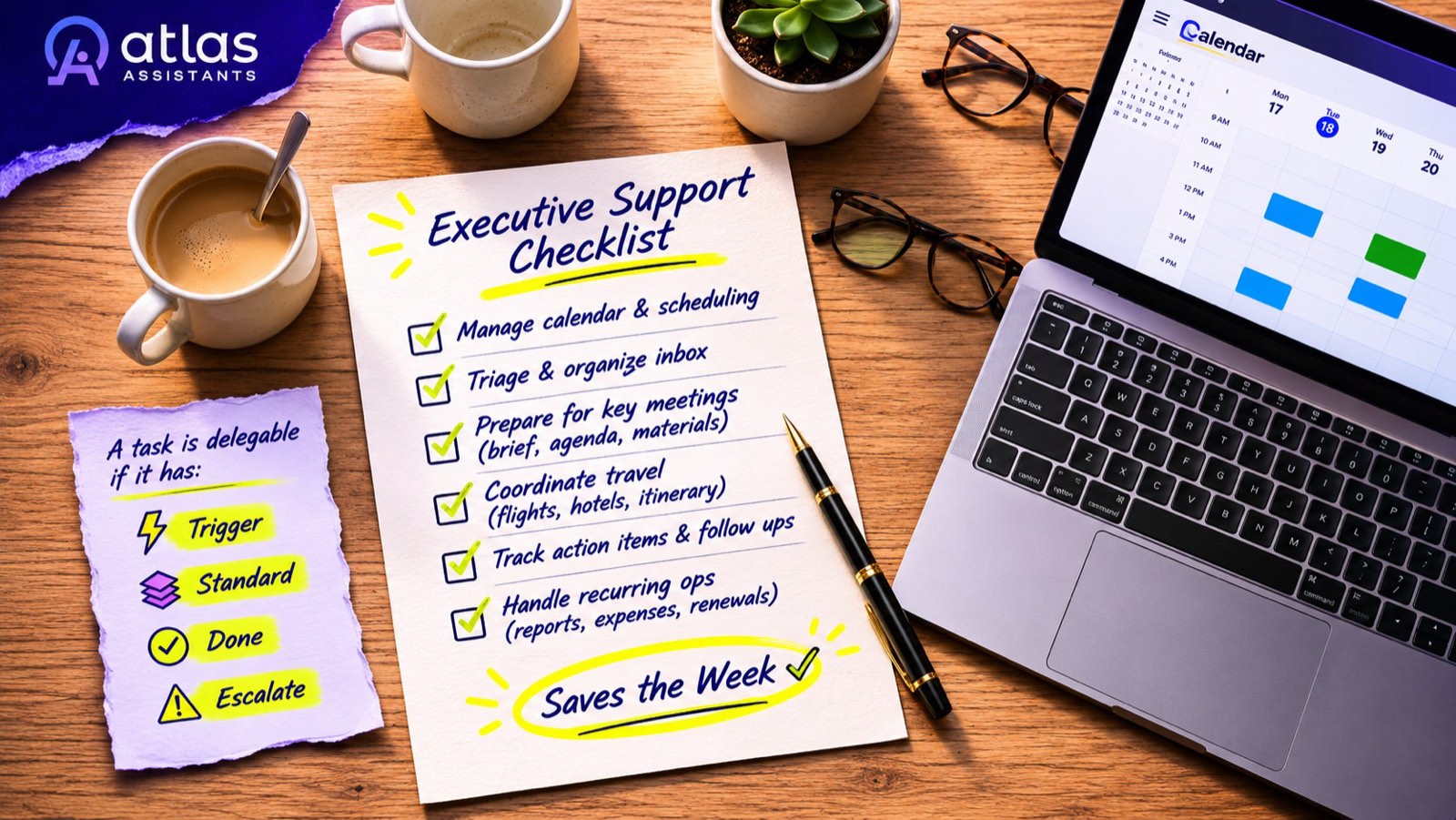
The Executive Support Checklist: Every Recurring Task Your Business Runs On
The fastest way to get your week back is not a better assistant. It is a complete list of the work that repeats, written so that someone else can own it. This is the list every Atlas operator is handed on day one.

Doing It Yourself With AI vs Hiring an AI Operator
You have ChatGPT, a Claude project and a Grok bot. So why pay a person? An honest comparison, including the cases where you should not.
You Can Make More Money.
You Cannot Make More Time
Two minutes to tell us where you are stuck. Then a conversation about whether this is the right moment for you.