
How Atlas Selects and Trains Operators
Over 2,000 people apply every week. About one in a hundred is placed. Here is what happens to the other ninety-nine, and what the one goes through before they ever see your inbox.
 Atlas Assistants
Last updated: 24 October 2026

- Two Thousand a Week
- What We Screen For, in Order
- The Seven Steps
- Why Industry Experience Is Overrated
- Trained Before Day One
- After Placement: Coaching, Pods and an Account Manager
- The Match Is Not a Lottery
- If You Are an EA Reading This
- Frequently Asked Questions
Key takeaways
- We screen for four things in order: organisation, proactive resourcefulness, problem solving under ambiguity, and leverage instinct. None of them is a tool.
- Seven steps. AI runs the first two so nobody waits weeks for an answer. People make every decision from step three on, and nobody is rejected by software alone.
- Training before placement, monthly coaching after it, and an account manager who owns the relationship. The selection is the start, not the end.
Founders ask us a version of the same question on every call: who are these people, and why would I trust one of them with my inbox?
Fair. Here is the whole process, from the two thousand applications that arrive in a typical week to the one person who ends up on an introduction call with you.
Two Thousand a Week
Over 2,000 people apply to Atlas every week. Roughly one in a hundred is placed with a client.
That ratio is not a marketing number, it is a consequence of what we are selecting for. Most applicants are capable administrators. Many would be a perfectly good assistant in the old sense of the word. Very few have the specific combination of judgment, ownership and tool fluency that the job now requires, and the process is built to find those few quickly and treat everyone else decently on the way out.
Tools are a fortnight. Judgment is not. So we hire for judgment first and train the tools.
What We Screen For, in Order
Years of experience in an EA role is a surprisingly weak predictor of whether someone will operate at the level founders need now. We screen for four things, in this order of importance.
- Organisation and attention to detail. Table stakes. Nothing falls through. If this is missing, nothing else matters.
- Proactive resourcefulness. They figure it out rather than wait. They bring the answer and two options rather than the question.
- Problem solving under ambiguity. They handle the thing that was not in any brief, because the real work never is.
- Leverage instinct. They reach for the thing that removes the task permanently rather than doing it faster by hand. This is the one that separates an operator from an assistant, and it is the rarest.
Notice that none of those are tools. Tools are a fortnight. Judgment is not. So we hire for judgment first and train the tools.
The Seven Steps
The process has seven steps in three phases. AI runs the first two, so a strong candidate gets an answer in days rather than weeks. People run everything from step three on, and nobody is rejected by software alone.
Phase One: AI Screening
1. A short video interview. Recorded on the candidate's own schedule, no live slot to book. A few questions about how they work and one piece of work they owned end to end. What we are listening for is how they talk about outcomes, not how they talk about tasks.
2. A skills assessment on real scenarios. Not a typing test. A full inbox with a client who has gone quiet, a calendar with a clash and a flight, a trip that changed on the day. The scenarios are the ones an Atlas operator faces in week one, and the assessment scores judgment as much as execution.
Phase Two: Human Review
3. A person reads everything. Our talent team goes through the recordings and the assessment results themselves. The AI steps sort and surface. They do not decide.
4. The talent interview. Thirty minutes with someone from the team that will eventually place them. What they are great at, what they want next, and the kind of founder they would say no to. That last answer tells us more about fit than anything on a CV.
Phase Three: Match and Place
5. The profile. We write up their strengths, tools, availability and the way they work, with them, into the profile a founder will read. If it does not sound like them, it is rewritten.
6. A paid trial, then matching. A short trial on real work, paid, so we see how they operate rather than how they interview. Then they join the bench, and when a founder's checklist, hours and pace fit theirs, we match them and explain to both sides why.
7. The introduction. A call with the founder, briefed by us beforehand. If it is right for both, there is a start date.
Why Industry Experience Is Overrated
The most common request we get from a new client is "someone who has worked in my industry." The most common thing we say back is: we can, and you probably should not want that.
Industry context is real and it is learned fast. A good operator picks up your vocabulary, your tools and your clients' rhythms in the first month, faster if it is written down in the Executive Atlas, which it is. What is not learned fast is judgment. The instinct to notice the client who went quiet. The sense of which week is different. The habit of writing things down so they survive.
When you select for industry experience you shrink the pool to people who have done a version of this job before, and the version they have done is usually the old one. When you select for judgment and train the context, you get someone who will still be right about what matters when your industry changes, which it will.
Trained Before Day One
Being selected is the start. Before an operator is placed, they go through the Atlas Executive Management System, the training built from everything we have learned placing operators with founders.
- Inbox systems. Labels, rules, triage, drafting in someone else's voice, getting to zero daily and keeping it there.
- Calendar and the ideal week. Designing a week around a founder's focus time and defending it.
- Travel end to end. Booking, rebooking, preferences, loyalty, the car at both ends.
- Meeting systems. Agendas, notes, follow-ups with owners and dates, and chasing them.
- Process writing. The four-part standard: trigger, standard, done, escalate. Every task they will ever take on is written this way.
- AI tools. Drafting, research, automation, agents for recurring work, and the discipline of reading every output before it goes anywhere.
- Working with founders. Daily notes, the Friday wrap, how to push back, how to escalate early.
Week one with you is real work, not a warm-up, because the warm-up already happened.
After Placement: Coaching, Pods and an Account Manager
The old model placed someone and wished you luck. Ours keeps going.
Every operator has monthly coaching, a pod of other operators doing the same job for different founders, and new skills added as the tools change. Your account manager owns the relationship: they check in monthly, catch problems before they reach you, and handle the conversations you would rather not have. If an operator is ill or on leave, cover is arranged from the bench and works from your written manual. If the fit is not right, you are rematched and your context carries across.
In practice. an operator who joined in the spring built her first agent, for a client's weekly report, in month two. By month four she had written it up well enough that another operator in her pod reused the pattern for a different founder. That is what the pods are for.
The Match Is Not a Lottery
The final thing to understand is that selection and training are only half of why it works. The other half is the match.
We do not place the next available person. We place the person whose hours fit yours, whose strengths fit the mix of work on your Executive Support Checklist, whose pace fits the way you described your week, and whose context will help in week one. Then we tell you why, in writing, before you meet them. If you read the profile and it does not feel right, we pick again. You have lost thirty minutes rather than three months.
If You Are an EA Reading This
Some of the people reading this are not founders. They are executive assistants wondering whether they would make it through.
If you own outcomes rather than tasks, write things down without being asked, and have ever built something that made a recurring task disappear, you should apply. The process is exactly as described above, and the careers page has the open roles, the benefits and what the first hundred days look like from your side.
Frequently Asked Questions
Where Are Atlas Operators Based?
Twenty countries and counting, with the largest groups in the Philippines, Kenya and Latin America. Every operator works your hours in your time zone, full time, for one founder.
Are They Employees or Contractors?
They are employed and paid by Atlas, with pay passed through to you at cost. You never run payroll, benefits or compliance for them.
Do They Need Experience in My Industry?
No, and we would rather they did not pretend to. We select for judgment, write your context into the Executive Atlas, and match for the mix of work on your checklist. Industry specifics are learned in weeks. Judgment is not.
What Happens If an Operator Leaves Atlas?
Your written processes, checklist and Executive Atlas belong to you. We rematch you from the bench and the new operator starts from the manual. Under 2 percent of clients leave in a given month, and most rematches are complete within two weeks.
Atlas places and trains executive operators, and coaches the founders who work with them. See what you are actually buying or book a call.
You Might Also Like
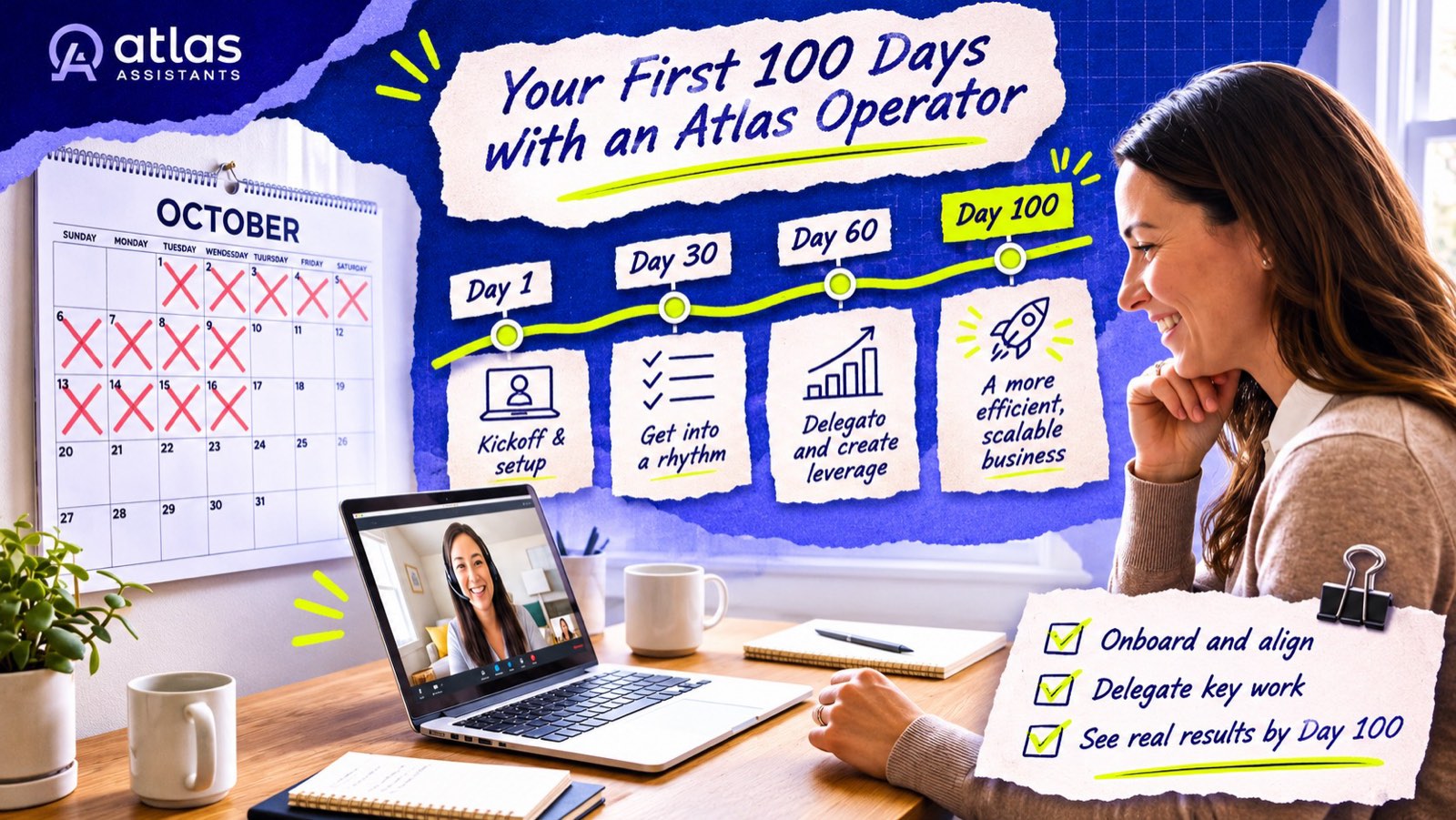
Your First 100 Days With an Atlas Operator
If you signed up today, this is what would happen, in what order, and what you would notice at day 7, day 30, day 60 and day 100.

What Atlas Operators Actually Do: Ten Real Weeks From Real Clients
Inbox and calendar are where it starts. Here is where it goes, told through the founders and operators it happened to.

Why Your Last Assistant Did Not Work Out
It usually was not the person. Two failures account for almost everything we see, and only one of them is about who you hired.
You Can Make More Money.
You Cannot Make More Time
Two minutes to tell us where you are stuck. Then a conversation about whether this is the right moment for you.