
Blog / Working With an Operator · 6 min read
What Atlas Operators Actually Do: Ten Real Weeks From Real Clients
Inbox and calendar are where it starts. Here is where it goes, told through the founders and operators it happened to.
 Atlas Assistants
Last updated: 23 October 2026

- Mornings
- Deals and Revenue
- Capacity
- Cover and Continuity
- What They Did With the Time
- The Pattern
- What This Means for Your First Month
- Frequently Asked Questions
Key takeaways
- It starts with the inbox and the calendar. Within a quarter it looks nothing like that.
- The pattern across every story is the same: capacity for the founder, continuity for the business, and someone who owns the outcome rather than the task.
- Every quote here is from a recorded client or operator interview. Where we have added context around a quote, it is marked.
Most people picture an executive assistant handling calendar and inbox. That is where every Atlas relationship starts, and if it stopped there it would still be worth it. It does not stop there.
Here are ten weeks from real clients and real operators, in their own words where we have them. Where we have added context around a quote, it is marked.
Mornings
The Inbox Is Done Before She Starts
Deb Gray, Founder, Deb Gray Consulting.
"He starts an hour before me. All my emails are gone through and I have a list that needs action. More time, more freedom, more confidence when I am away."
This is the foundation, and it is the one almost every client mentions first. The operator works the hour before the founder's day begins. By the time Deb opens her laptop, the inbox has been triaged, the replies that can be drafted are drafted, and the list of things that genuinely need her is short and in order. The confidence when she is away is the part that compounds: the business keeps moving when she does not.
Not Checking Email Until Nine
Wade Bartels, CEO, SimpliCity Real Estate.
"I used to wake up checking email. Today I am comfortable not checking it until I am in the office at nine. If something is urgent, my EA tells me."
The phrase that matters is the last one. The reason Wade can leave the inbox alone is not discipline. It is that someone else owns the judgment about what is urgent, and he trusts it. That trust was built in the first month, through drafts approved and exceptions written down, until the morning check became unnecessary.
Don't think of it as an expense. Think of it as an investment that frees you up.
Deals and Revenue
Three Deals, Because the Match Was Fast
Troy Ericson, CEO, Email Paramedic.
"They found someone in days. Because of that we closed three deals. I cannot recommend them enough."
Speed of matching is usually described as a convenience. Here it was revenue. The operator arrived while the pipeline was live, took over the follow-ups and the scheduling, and three deals that would have slipped got closed. Context: the operator was matched within the standard fourteen-day window and took over proposal follow-up in week one.
The Company Doubled
Dannie Strable, Founder, Rackhouse Connect.
"She created more capacity for me and the company. That let me focus on the business, and we doubled it in a few short months."
Capacity is the word. Nothing on Dannie's checklist was dramatic on its own: inbox, calendar, coordination, follow-up. Together they returned enough of his week that he could do the work only he could do, and the business responded. This is the growth question from our first call, answered in the only way that counts.
Revenue up at a California Law Firm
Liova Perez, Executive Operator.
Liova helped her client's California law firm grow revenue and win more clients through calendar control and documented process.
Told from the operator's side. A law firm's revenue is a function of billable hours and new matters, and both were leaking through a calendar nobody controlled and intake nobody had written down. Liova took the calendar, wrote the intake process, and the firm started winning the clients it had been losing to slow replies.
Capacity
Wearing Every Hat, Then Not
Josh Bergeron, Founder, Tikun Collective Design.
"I was wearing every single hat. It's given me the ability to rise to being able to do new things."
The founder of a small design studio does not have an admin problem. They have a capacity problem that looks like an admin problem. Handing over the recurring work did not make Josh more organised. It gave him room to do new things, which is the actual return.
An Investment, Not an Expense
Matthew Moheban, CEO, 220 Youth Leadership.
"It's hard to overstate how valuable she's been. Don't think of it as an expense. Think of it as an investment that frees you up."
We put this quote on the homepage because it is the reframe every cost conversation needs. The maths behind it is here.
Confidence to Do More
David Lindover, CEO, Partner Marketing Works.
"I've tried numerous executive assistant models and they have not worked. Taking the low hanging fruit and optimizing that for me was liberating. What it has really given me is the confidence to do more."
David had tried this before and it had not worked. The difference this time was order: the low-hanging fruit first, the recurring work that was quietly eating his week, done properly and written down. Confidence came after that, not before. Why the earlier attempts fail is here.
Cover and Continuity
Three Months of Maternity Cover
Sheila Ngaruiya, Executive Operator.
Sheila held an executive's entire office together through three months of maternity cover, backed by a dedicated account manager.
This is the story that explains why the written manual matters. An executive went on maternity leave for three months. The operator ran the office in her absence: inbox, calendar, the team's questions, the things that would otherwise have waited. The account manager was the escalation point for anything outside the written rules. Three months later the executive came back to a business that had kept running, which is the only kind of leave that is actually leave.
Beyond What a Traditional Assistant Could Do
Chris Piper, COO, Contrarian Thinking.
"Atlas is the cheat code to finding world-class support, beyond what I thought a traditional assistant could do. From sourcing to onboarding to ongoing coaching, A+ across the board. Now I cannot imagine my life without my assistant."
A COO's view, which is useful because COOs are the people who notice when systems are missing. The three things he names are the three things the old model did not include: sourcing, onboarding, and coaching that continues.
What They Did With the Time
Staying in the Zone
Mac Lackey, Founder, Exit DNA.
"I needed to stay in my zone of expertise. My EA gives me time not just for the important work, but for the things I love."
The last story is the one the whole model is for. The time comes back, and then the question is what it is for. For Mac it was his zone of expertise and the things outside work that had been crowded out. That is the "fuller lives" half of the sentence on our homepage, and it is not a slogan. It is what the hundredth day looks like when the first ninety-nine were done in the right order.
The Pattern
Read the ten together and the same three things appear in every one.
Capacity for the founder. The recurring work leaves, and what fills the space is the work only the founder can do. Deals, doubling, new things, the zone of expertise.
Continuity for the business. Mornings that run before the founder is awake. An office that holds together through three months of leave. Follow-ups that do not depend on anyone's memory.
Someone who owns the outcome. Not the task. Wade's operator decides what is urgent. Deb's operator decides what needs her. The judgment is delegated, which is the step most assistant relationships never reach.
What This Means for Your First Month
None of these founders started with a doubled company or a three-month leave. They started with an inbox, a calendar and the Energy Audit. The bigger outcomes came because the small ones were done properly and written down, in an order that made each one easier than the last.
If you want to know what that order is, start here. If you want to hear the full interviews, every one of these is on the homepage, recorded by the clients themselves and unedited by us.
Frequently Asked Questions
Are These Real Clients?
Yes. Every quote is taken from a recorded interview on our public reviews page, and the full videos are linked from the homepage. Context added around a quote is marked as such and is being confirmed with each client before publication.
How Quickly Did These Founders See Results?
The inbox and calendar changes happen in the first two to four weeks for almost everyone. The larger outcomes here, the deals, the doubling, the maternity cover, happened over months, once the recurring work was owned and the operator had capacity to do more.
Do All Operators Do All of This?
Every operator runs the same foundation: inbox, calendar, travel, meetings, follow-ups, reporting, and the written manual. What sits on top depends on the founder, the business and the operator's strengths, which is what the matching is for.
Can I Speak to One of These Clients?
Several of them take reference calls. Ask on the clarity call and we will arrange it.
Atlas places and trains executive operators, and coaches the founders who work with them. See what you are actually buying or book a call.
You Might Also Like

Your First 100 Days With an Atlas Operator
If you signed up today, this is what would happen, in what order, and what you would notice at day 7, day 30, day 60 and day 100.
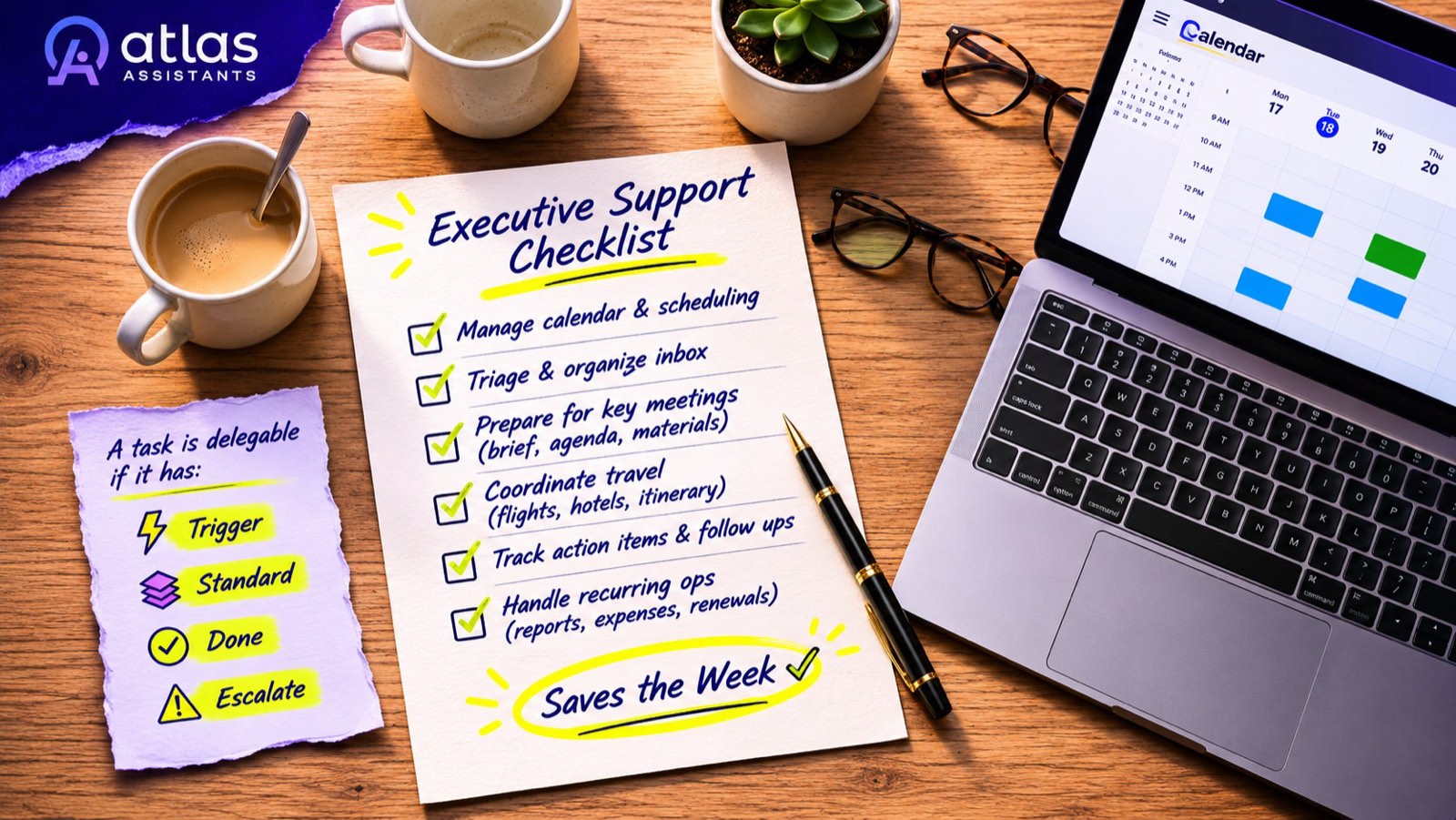
The Executive Support Checklist: Every Recurring Task Your Business Runs On
The fastest way to get your week back is not a better assistant. It is a complete list of the work that repeats, written so that someone else can own it. This is the list every Atlas operator is handed on day one.

How Atlas Selects and Trains Operators
Over 2,000 people apply every week. About one in a hundred is placed. Here is what happens to the other ninety-nine, and what the one goes through before they ever see your inbox.
You Can Make More Money.
You Cannot Make More Time
Two minutes to tell us where you are stuck. Then a conversation about whether this is the right moment for you.