
Blog / Delegation · 6 min read
What to Delegate First, and the Order That Actually Works
Everything feels too important, too hard to explain or too small to bother with, so nothing moves. Here is the sequence we use with every new client, and what the human actually does with each task once AI is in the room.
 Atlas Assistants
Last updated: 26 October 2026

- Why Nothing Moves
- Rule One: Recurring Before Projects
- The Order
- The Task vs What the Human Does With It
- The First Week Script
- What to Keep
- The Mistake Everyone Makes in Month Two
- Frequently Asked Questions
Key takeaways
- Recurring before projects. Always. The project feels like the bigger relief and it is the smaller one.
- Inbox, then calendar, then travel, then meetings. In that order, because each one makes the next easier to hand over.
- For every task on the list, the question is no longer 'can AI do this?' It is 'who owns it, and who reads the output?'
Ask most founders why they have not delegated more and you get one of three answers. It is too important to hand over. It would take longer to explain than to do. It is too small to bother someone with.
All three are true of individual tasks and false of the week as a whole. The way out is not willpower. It is order. Hand things over in the right sequence and each one makes the next easier.
This is the sequence we use with every new client, and because AI is now in every room, we have added the column that matters most: what the human actually does with each task once the tools are involved.
Why Nothing Moves
Delegation stalls because every task, looked at on its own, has a good reason to stay with you. The inbox has the client in it. The calendar is your week. The travel is your trip. Each is a small decision not to hand over, and forty small decisions a week add up to a founder who delegates nothing and cannot say why.
The fix is to stop deciding task by task. Decide the order once, then work through it.
Delegate the task that repeats, not the task that hurts. The one that hurts will still be there next month. The one that repeats will not.
Rule One: Recurring Before Projects
Delegate the task that repeats, not the task that hurts. The one that hurts will still be there next month. The one that repeats will not.
Projects feel like the bigger relief because they are the bigger weight right now. But hand over a project and you have saved its hours once. Hand over the weekly report and you have saved two hours every week for as long as the company exists. Over a year, the small recurring task beats the big project every time.
There is a second reason. Recurring work is where the mistakes hide: the invoice nobody chased, the follow-up that went out a fortnight late. Handing it to an owner does not just save your time. It stops the quiet leaks.
So the first pass is only recurring work, in the order below. The projects come after, and by then you will have an operator who knows your business well enough to take them.
The Order
- Inbox. First, always. It is where the most hours go and where the most other work originates. Start with triage and drafts for your approval. Move to full ownership once you have seen enough drafts in your voice.
- Calendar. Second, because once someone owns your inbox they already know who is asking for your time. The ideal week gets built, focus blocks get protected, and the next-day brief starts arriving every evening.
- Travel. Third, because it is bounded, visible and high relief. Flights, hotels, cars, itineraries, loyalty programmes. One trip done end to end builds more trust than a month of small tasks.
- Meetings. Agendas in advance, notes during, every follow-up chased after. This is the step where founders notice the business feels different, because things that used to be said in meetings start getting done.
- Follow-ups and CRM hygiene. Proposals chased on day three and day ten. Deals updated after every call. The pipeline stops depending on your memory.
- Reporting. The Monday numbers, the client status emails, the board update. Pulled, drafted in your voice, read by a human, sent.
- Automations. Now, and not before. Once the recurring work is mapped and running by hand, your operator knows exactly which parts repeat enough to be worth automating, and can watch the output because they know what right looks like.
- Home and family. Last on the list and first in regret. The hours you got back will be eaten by the household unless this is handed over too. We wrote about why.
Two weeks for the first two. A month for the first four. The rest across the first hundred days.
The Task vs What the Human Does With It
Here is the question that has changed. Five years ago the question was "can I hand this to a person?" Today it is "can AI do this?", and for most of the list the honest answer is "most of it, badly, unless someone is watching."
So the useful column is not whether the tool can do the task. It is what the human does with it.
| The task | What AI does | What your operator does |
|---|---|---|
| Inbox triage | Sorts, labels, suggests replies | Decides what matters this week, drafts in your voice, catches the one email the filter got wrong |
| Calendar | Finds slots, sends invites | Protects your focus time against the people who want it, moves Thursday around the flight, says no on your behalf |
| Travel | Searches options | Books the aisle seat and the car at both ends, rebooks at 11pm when the flight is cancelled |
| Meeting notes | Transcribes and summarises | Turns the summary into three follow-ups with owners and dates, then chases them |
| Invoice chasing | Sends the templated reminder | Notices the client who always pays late is now very late, and picks up the phone |
| Weekly report | Pulls numbers, drafts the summary | Reads it, fixes the two things the agent got wrong, sends it |
| Research and first drafts | Produces them in seconds | Checks the facts, applies your judgment about what is actually relevant, cuts it to what you need |
| New automations | Runs when built | Decides what should be automated, builds it to a written standard, reads the output every day |
Read down the right-hand column and a pattern appears. The human is not doing the task. The human is owning the outcome, operating the tool, and applying the judgment the tool does not have. That is the job now, and it is the job we train for.
The First Week Script
What you actually say to your operator on day one, if you want the first two weeks to work.
"Here is the inbox. For the first week, triage it and draft replies for me to approve. Flag anything from these ten people immediately. Everything you learn about how I like things done, write down. On Friday, show me the list and tell me what you would change."
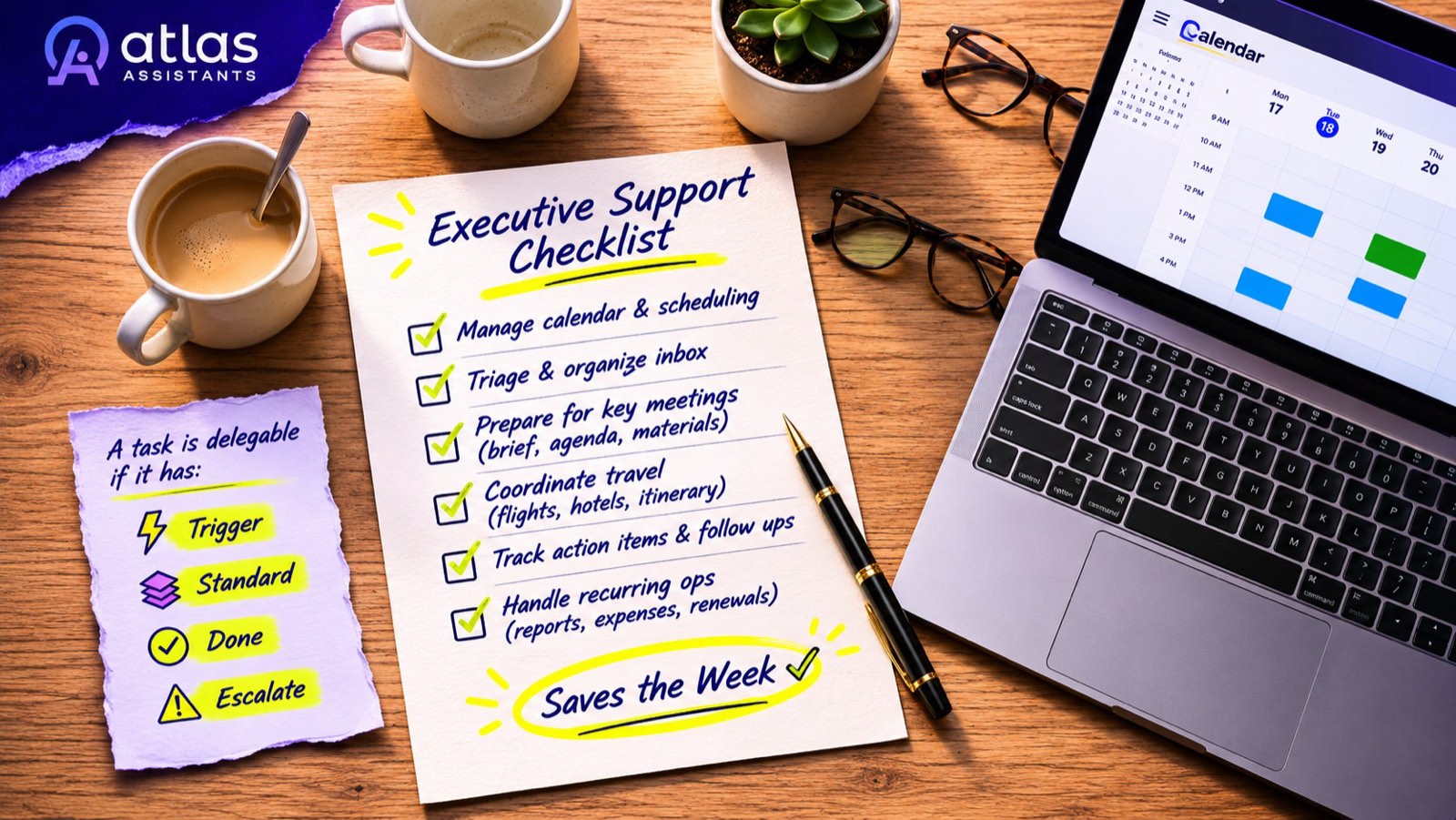
Four sentences. The first gives the scope. The second gives the exceptions. The third starts the Executive Support Checklist. The fourth makes the Friday wrap a habit from week one.
What you do not say: "just help me get organised." Nobody can act on that, and the good ones will spend a week trying to guess what you meant.
What to Keep
Not everything goes. Four things stay with you, and seeing them as a short list is useful in itself.
- Money above your threshold. Set the number. Everything below it is your operator's call within the written rules.
- Hiring decisions. Your operator coordinates the process. You decide.
- The first conversation with a key client or partner. After that, the relationship is maintained by your operator and you step in when it matters.
- The hardest problem in the business this quarter. This is your actual job. The point of everything else on this page is to get your week down to this.
The Mistake Everyone Makes in Month Two
Month one goes well. Inbox and calendar are handled, the first trip was booked properly, the Friday wrap is a habit. And in month two, the founder starts handing over the projects. All of them. At once.
The rebrand. The new pricing page. The hiring process. The event. Each one is a sensible thing to delegate and together they bury the operator in work that has no written process yet, while the recurring work, which did have one, starts to slip.
The order holds in month two as well. One project at a time, written up as it goes, and if it turns out to recur, it joins the checklist. The recurring work is the foundation. The projects sit on top of it, not instead of it.
If you want the full list of what should be on that foundation, by day and week and month, the Executive Support Checklist is the place to start.
Frequently Asked Questions
Should I Start With the Thing I Hate Most?
Only if it also repeats. The task you hate most is usually a project, and delegating a project saves its hours once. Start with the weekly loop and the thing you hate will have its turn in month two.
How Much Should I Hand Over in Week One?
Two systems: inbox and calendar. Nothing else. Done properly those two take a fortnight and change how the rest of your week feels, which makes everything after easier.
What If I Do Not Trust Anyone With My Inbox?
Start with read access and drafts for approval. You keep the send button. Most founders hand it over within three weeks once they have seen fifty drafts in their own voice.
What Should I Never Delegate?
Decisions that are genuinely yours: money above your threshold, hiring, the first conversation with a key client, and the hardest problem in the business this quarter. Everything around those decisions can go.
Atlas places and trains executive operators, and coaches the founders who work with them. See what you are actually buying or book a call.
You Might Also Like
The Executive Support Checklist: Every Recurring Task Your Business Runs On
The fastest way to get your week back is not a better assistant. It is a complete list of the work that repeats, written so that someone else can own it. This is the list every Atlas operator is handed on day one.

Doing It Yourself With AI vs Hiring an AI Operator
You have ChatGPT, a Claude project and a Grok bot. So why pay a person? An honest comparison, including the cases where you should not.

Why Your Last Assistant Did Not Work Out
It usually was not the person. Two failures account for almost everything we see, and only one of them is about who you hired.
You Can Make More Money.
You Cannot Make More Time
Two minutes to tell us where you are stuck. Then a conversation about whether this is the right moment for you.