
Blog / Masterclass · 6 min read
The Leadership Playbook That's Costing Your Health and Freedom, With Davide Viola
You cannot outwork bad biology or bad systems. Fortune 500-trained CEO Davide Viola on inertia, minimum effective dose, hiring for wiring, and why the next version of leadership runs on harmony rather than grind.
 Colin Pal
Recorded 29 April 2026 · Published 2 November 2026
- You Cannot Outmind Bad Biology
- Which Way Is Your Inertia Going?
- Living by Design, Not by Default
- The AI Trap: Because I Can, I Should
- Burnout, and the Three Thirds
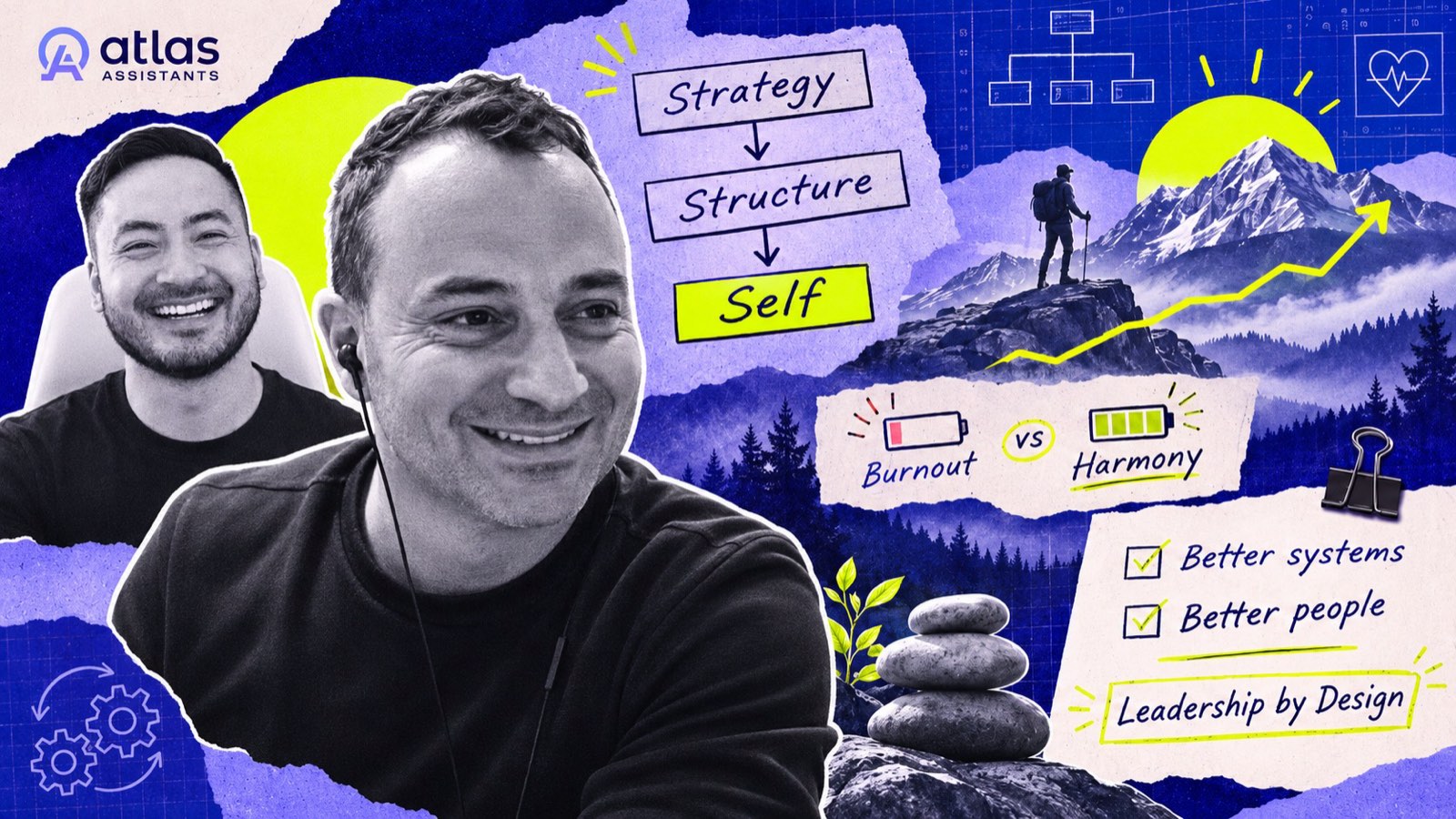
- Strategy, Structure, Self
- ROI = H + AI
- The Two-Day Work Week
- What to Take Away
- Frequently Asked Questions
Key takeaways
- Good systems make good people stronger. Bad systems break good people. Start from the source: the system of your business and the system of your body.
- Check your inertia. Is it going up, sideways or down? That one question tells you what to change first.
- Strategy, structure, self. Most companies miss the third: hiring people who are wired for the job, not people who remind you of you.
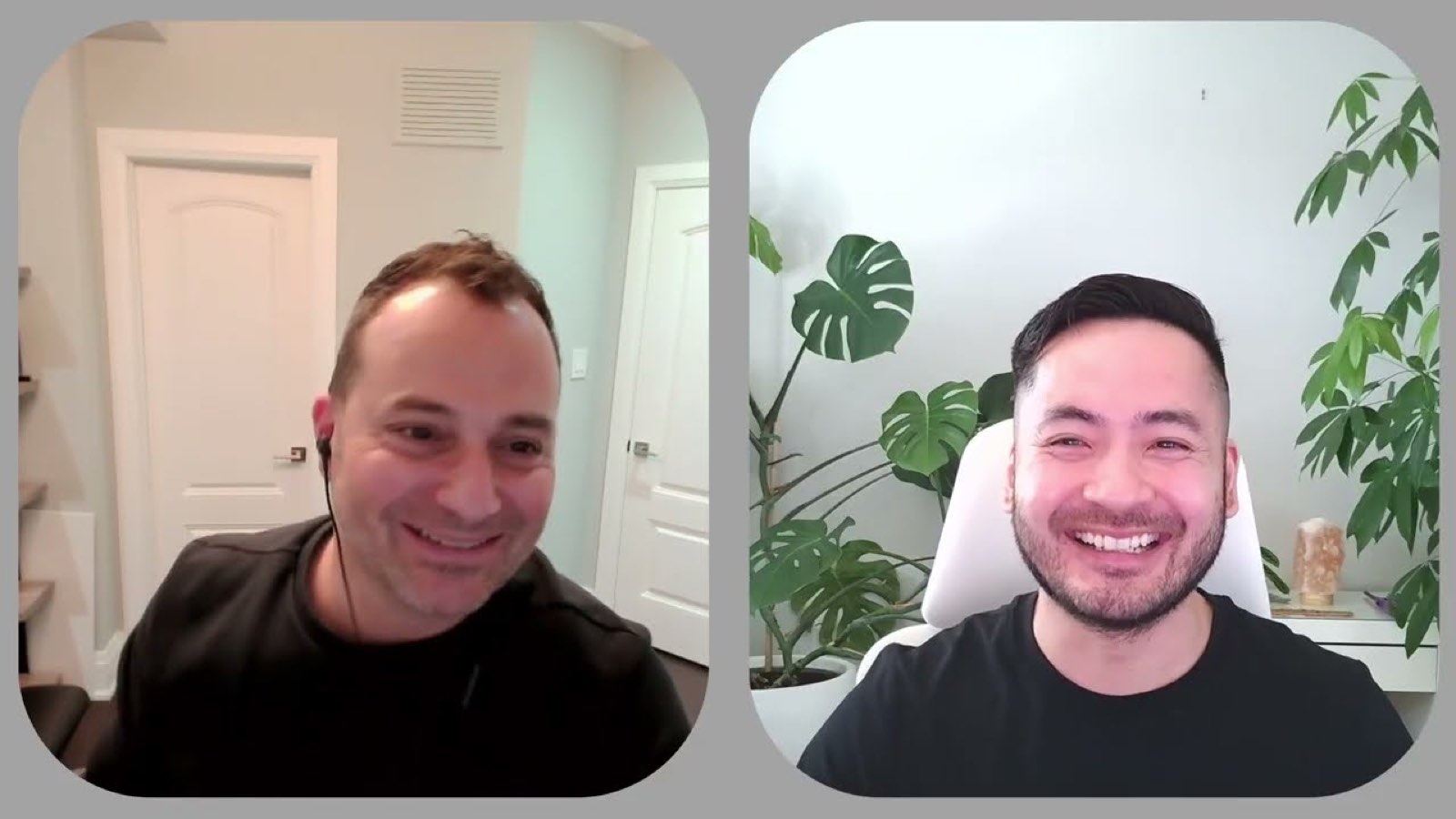
Colin has a line he likes from Davide Viola: business is his NHL. He never stops studying the game. Davide has led nine-figure P&Ls through turnarounds and transformations, and he has also lived the cost of running hard without systems. This masterclass is about that cost, and the fact that it is a systems problem rather than a personal failing.
Watch on YouTube · More from the Atlas channel
You Cannot Outmind Bad Biology
The biggest mistake Davide sees in founders and CEOs comes from a friend who played in the NHL: you cannot outmind bad biology. Most of us try. We hustle through, push harder, ignore the body. Davide adds the business half: you cannot outperform bad systems either. Good systems make good people stronger. Bad systems break good people.
His audio analogy: you are better off with a great amp and average speakers than the other way round. It starts at the source, and the source is always the system of your business and the biology of the person running it. Society celebrates the grind because it works, until it does not, and the costs he has seen first-hand are relationships, health and diagnoses people do not recover from.
You cannot outmind bad biology. And you cannot outperform bad systems.
Which Way Is Your Inertia Going?
Why do we stay stuck even when we know better? Davide's answer is inertia. Momentum is as real in behaviour as it is in physics. Miss the gym for a week and the habit calcifies the other way; two years later you have gained thirty pounds and stopped playing tennis with your friends. The question he wants every leader to ask is simple: where is my inertia going right now? Up, sideways or down? If it is down, something has to change. If it is up, protect it.
Living by Design, Not by Default
Jack Welch's line, show me your calendar and I will show you your values, is how Davide tracks it. Supplements by the bed. A ring that tracks HRV and sleep. Thinking time and workout time blocked in the calendar. Reminders for everything, including the home air filter every three months. People call it rigid. He calls it pattern interrupts that take five minutes a day.
The proof: in a November that stacked TED talk applications, a board meeting, a conference and a Harvard AI course, his ring showed him not stressed on 27 of 30 days. Not by accident. By design. "If you don't clean out your closet, someone else will do it for you. People will take your time because they need what they need. You are the chief executive officer of your own life."
Colin's version at Atlas: every time block in his calendar is tagged against his zone of genius, excellence, competence or incompetence, and he and his EA track the ratio week over week. If the operational share is creeping up, that is the inertia signal, and the system gets redesigned before the month is gone.
The AI Trap: Because I Can, I Should
Both of them admit to the same new failure mode. AI lets you produce so much more, so quickly, that the discipline slips: you give up the gym slot or the morning thinking time to tinker with one more agent. Davide's test is energy. If the late-night build is still energising, fine. If it has tipped into frustration and the body is telling you so, you went too far. The muscle to train is listening to that signal.
Burnout, and the Three Thirds
Davide's layman's definition of burnout is not a breakdown. It is not having the energy for what you actually want to do once work is done. Underneath it is biology: stress drives inflammation, inflammation drives most disease, and most of us are running a body on a schedule it was not built for. The marathon runner who collapses at the line was doing everything "right" for a body wired for sprints.
The frame he uses is three thirds. A third of your life sleeping, where the body does its repair. A third working. A third living: family, cooking, friends. The Management OS exists to put those three into harmony rather than let the middle third eat the other two.
Strategy, Structure, Self
Where do you start changing a company? Davide's three pillars:
- Strategy is where we are going. If the plan does not fit on one page, it does not fit in anyone's head. Harvard's numbers: 90 percent of companies have no real plan, and of those that do, most never execute it.
- Structure is how we get there: SOPs, value stream mapping, meeting cadence, KPIs, dashboards.
- Self is who does what, and it is the pillar almost everyone misses. Hiring for skills is well understood. Hiring for wiring is not.
In practice. helping a chiropractor friend hire an office manager, Davide ran the rule of six (interview six, you will find the person; more confuses, fewer misses) and a behavioural assessment. Three finalists were wired like the founder: ideas people, mavericks. One was wired for process and schedule. She liked the ones like her. She needed Edwin, the process person, and he is the one who thrived in the job. Picking people who remind you of you is one of the three reasons most Inc. 5000 companies disappear by year three.
Behavioural tools like Predictive Index or Working Genius cost a few hundred dollars a person now. Davide also uses genetic profiles (Life DNA, The DNA Company) for himself and his senior team, not to change anyone, but to know the blueprint they are working with. His argument is that a leader has a fiduciary duty to profit and the same duty to the health and joy of their people, and no operating system he has seen talks about the second half.
ROI = H + AI
Does AI change the Management OS? Davide says it was born of it. AI codifies the frameworks that work and crunches the boring work faster. But the return is human experience plus AI, not AI alone. His image: a $10,000 titanium hammer. Give it to most of us and we hang a picture slightly faster. Give it to a carpenter and he builds the house faster, straighter and with less fatigue. The tool multiplies whatever knowledge is holding it. A one-line prompt and a 27-page brief produce night-and-day results for the same reason.
On where people stay essential: you do not put the fox in charge of the henhouse. Someone with lived experience has to provide oversight, direction and the gut sense of which of the hundred experts in the room to listen to. Colin connects it to Jack Dorsey's point that the job of AI in an organisation is to maintain the intelligence layer so humans can do the critical thinking and decision-making, which is exactly the shape of the Atlas operator role.
The Two-Day Work Week
If AI gives you 10x output, why do five days times ten? Why not two days times ten, which is still four times what you had, and spend the other five with your kids, on a mountain, learning pickleball? Davide puts it out there as a picture you can design towards. Colin shares Atlas's step in that direction: maker days, where every manager spends Tuesday in one room getting the week's priorities done in a day, because the time-consuming part of most work was never the thinking. It was the knowledge transfer and waiting on decisions that AI now removes.
What to Take Away
Two things. First, check your inertia and be honest about the direction. Second, for everything you do, ask for the minimum effective dose: the least people, time, money and energy that gets the outcome. Then change one small thing a week, because even the disciplined cannot change everything at once, and compounding does the rest. And have fun. None of it matters if you are not.
Frequently Asked Questions
Who Is Davide Viola?
A Fortune 500-trained CEO with twenty-five years running national organisations across consumer goods, retail and healthcare in Canada and the US, and the creator of the Management OS, a system for executives covering strategy, operations and talent.
What Is the Management OS?
A set of repeatable rhythms across three pillars, strategy, structure and self, that treats the leader's biology and the business's systems as one thing to design, not two.
How Does This Connect to Working With an Operator?
Davide's inertia check and Colin's weekly review with his EA are the same practice: look at the calendar, track where the week actually went, and redesign the system before it calcifies.
Atlas places and trains executive operators, and coaches the founders who work with them. See what you are actually buying or book a call.
You Might Also Like
The Founder Bottleneck Is a Team-Size Problem
Nobody becomes the bottleneck on their own. It happens the quarter after you hire. Here is why it is structural, how to measure it in one question, and what to move first.
Your First 100 Days With an Atlas Operator
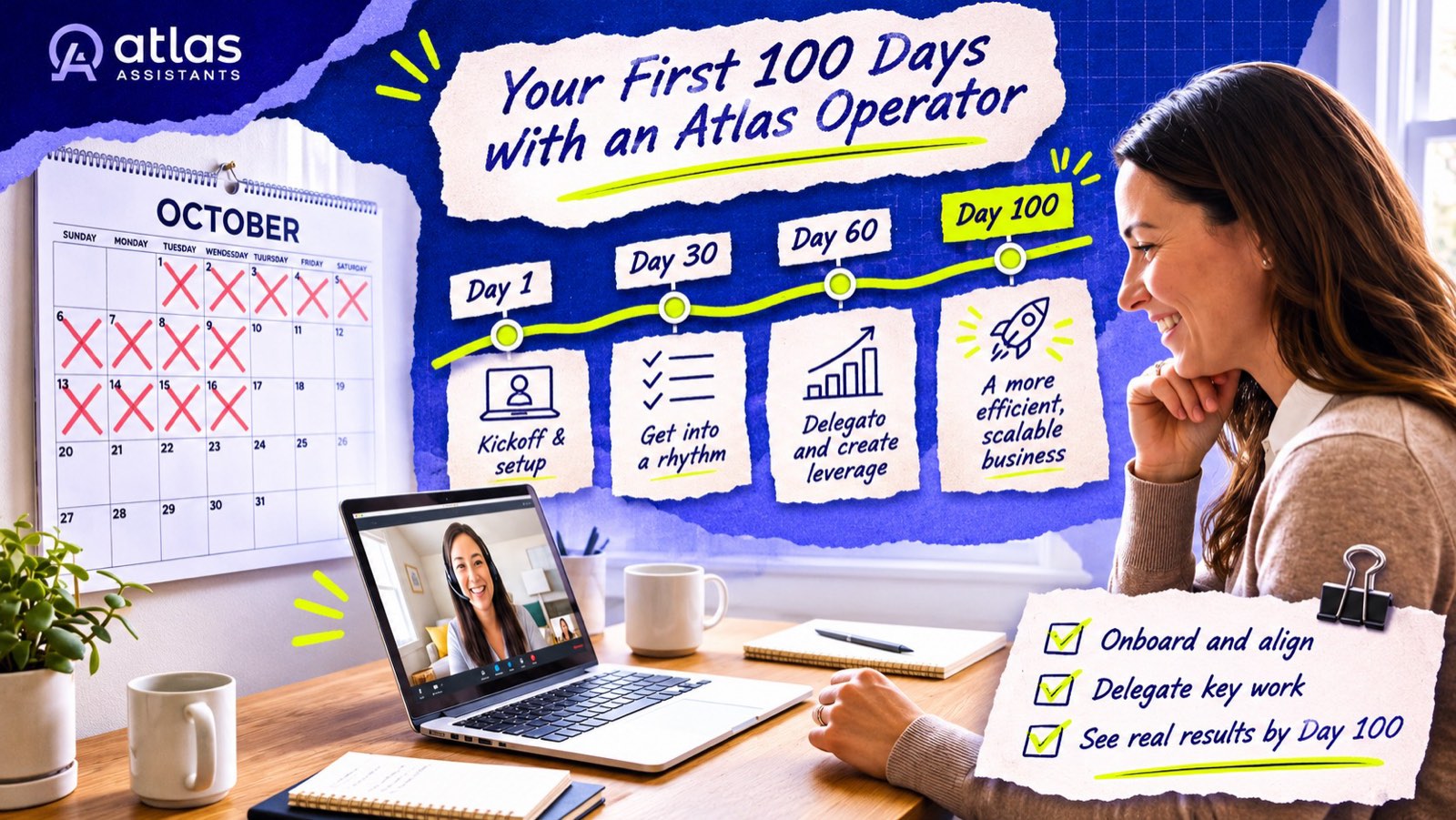
If you signed up today, this is what would happen, in what order, and what you would notice at day 7, day 30, day 60 and day 100.
What to Delegate First, and the Order That Actually Works
Everything feels too important, too hard to explain or too small to bother with, so nothing moves. Here is the sequence we use with every new client, and what the human actually does with each task once AI is in the room.
You Can Make More Money.
You Cannot Make More Time
Two minutes to tell us where you are stuck. Then a conversation about whether this is the right moment for you.